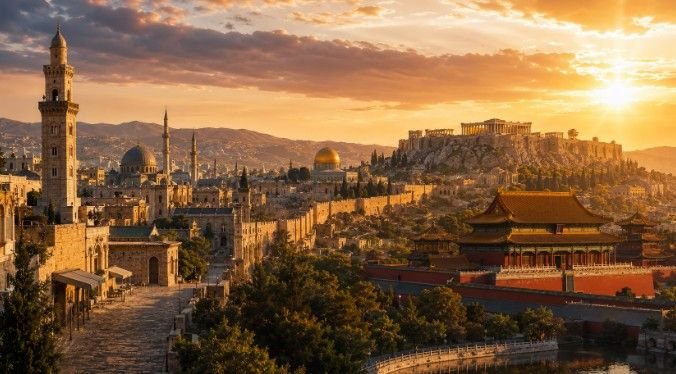
History feels much more exciting when you realize that some of today’s capitals were already thriving while entire civilizations were still taking shape. Exploring the oldest capital cities worldwide reveals how ancient settlements evolved into political, cultural, and economic centers that continue to influence modern nations.
These remarkable capitals connect the present with thousands of years of human achievement, making them some of the most fascinating places on Earth.
Key Takeaways
- Damascus is widely recognized as the world’s oldest continuously inhabited capital city.
- Many ancient capitals remain important political and cultural centers today.
- A city’s age and its capital status are often two different timelines.
- Ancient capitals preserve national identity, heritage, and traditions.
- These cities provide valuable insights into world civilizations and country facts.
Why Getting to Know This Is So Fascinating
The story behind the oldest capital cities worldwide is far more interesting than a collection of dates. These cities have survived wars, empires, trade revolutions, and political transformations while continuing to serve as symbols of national identity.
Learning about ancient capitals also makes country facts easier to remember. Instead of memorizing capitals from a map, you discover the stories, cultures, and civilizations that helped shape entire nations.
What Makes A Capital City Truly Ancient?
Understanding ancient capitals requires looking beyond simple founding dates.
Age And Capital Status
Many cities existed for centuries before becoming official capitals. Historians separate the age of a settlement from the date it gained political importance. This distinction helps create a more accurate comparison among historic capitals.
A city may be incredibly old yet have served as a capital for only a portion of its history. This difference often surprises readers exploring ancient world capitals for the first time.
Continuous Human Settlement
Experts frequently use continuous habitation as an important benchmark. Cities that remained populated through multiple historical eras provide stronger evidence of long-term significance.
Continuous settlement demonstrates resilience. It shows that generations of people found reasons to live, work, and govern from the same location across centuries.
The World’s Oldest Capital Cities
These capitals stand out for their extraordinary historical timelines and enduring national importance.
Damascus, Syria
Damascus is widely recognized as the oldest continuously inhabited capital city in the world. Dating back to around 2500 BC, it is officially acknowledged by Guinness World Records as the oldest capital in recorded history.
For thousands of years, Damascus served as a crossroads connecting Asia, Africa, and Europe. Its strategic location helped establish it as a center of trade, culture, and political power that continues to define Syria today.
Athens, Greece

Athens has been inhabited for roughly 5,000 years and remains one of the most influential cities in human history. It played a central role in shaping philosophy, democracy, literature, and education.
As the capital of Greece, Athens blends ancient landmarks with modern governance. Its historical importance extends far beyond Europe and continues to influence societies worldwide.
Jerusalem
Jerusalem holds a unique place in world history because of its religious and cultural significance. Evidence suggests continuous habitation spanning thousands of years under numerous kingdoms and empires.
Today, Jerusalem remains one of the world’s most recognizable cities. Its historical importance attracts scholars, pilgrims, and travelers from nearly every corner of the globe.
Beirut, Lebanon
Beirut’s history stretches back more than 5,000 years to the era of the Phoenicians. Throughout history, the city witnessed the influence of various civilizations, including the Romans and Ottomans.
As Lebanon’s capital, Beirut remains a major cultural and economic center. Its long history reflects the diversity and resilience of the Lebanese people.
Beijing, China
Beijing traces its development as an important settlement and imperial capital to the first millennium BC. Several Chinese dynasties established the city as a political center.
Today, Beijing serves as the capital of China and remains one of the most influential cities in the world. Its historical monuments showcase centuries of imperial heritage.
More Ancient Capitals Worth Knowing
Several other capitals deserve recognition for their remarkable longevity.
Rome, Italy
Rome emerged as a powerful center of governance, engineering, and culture during the Roman Empire. Its influence shaped legal systems, architecture, and political structures throughout Europe.
Modern Rome continues to serve as Italy’s capital while preserving countless reminders of its extraordinary past.
Yerevan, Armenia

Founded in 782 BC, Yerevan ranks among the world’s oldest continuously inhabited cities. Its origins can be traced to the ancient Erebuni Fortress. The Armenian capital offers a compelling combination of archaeological heritage and modern urban development.
Sanaa, Yemen
Sanaa has remained an important settlement for thousands of years. Its historic architecture and cultural traditions make it one of the Arabian Peninsula’s most distinctive capitals. The city continues to represent an important part of Yemen’s historical and national identity.
Capital Cities Through The Ages
Ancient capitals tell stories that extend beyond national borders.
Centers Of Trade
Many of the oldest capitals developed along important trade routes. Merchants, travelers, and explorers contributed to their growth and prosperity. These commercial connections helped spread ideas, technologies, and cultural traditions between civilizations.
Seats Of Power
Governments often selected these cities because of their strategic locations, economic strength, or symbolic importance. Their political influence helped shape regional history. Over time, these capitals became centers where major decisions affected millions of people across vast territories.
Guardians Of Heritage
Ancient capitals preserve monuments, traditions, and historical records that help modern societies understand their origins. Their continued existence provides valuable insight into how civilizations adapted and evolved over thousands of years.
How To Use Knowledge Of Oldest Capital Cities Worldwide
Learning about the oldest capital cities worldwide can be both educational and practical.

Step 1: Connect Capitals With Countries
Start by linking each ancient capital to its modern nation. This makes country facts easier to remember and improves geographic knowledge.
Understanding these connections creates a stronger foundation for learning about world history and international cultures.
Step 2: Explore Historical Timelines
Next, compare when each city was founded with when it became a capital. This helps reveal how political systems changed over time. Historical timelines also provide context for major events that shaped nations and civilizations.
Step 3: Discover Cultural Significance
Finally, examine the cultural contributions of each capital. Many introduced innovations in government, architecture, religion, and education. This approach transforms simple facts into memorable stories that are easier to understand and share.
Frequently Asked Questions
1. What are the 10 oldest cities in the world?
The list commonly includes Damascus, Jericho, Byblos, Aleppo, Susa, Sidon, Faiyum, Beirut, Jerusalem, and Plovdiv. Exact rankings vary because archaeological discoveries continue to refine historical timelines.
2. What are the 12 oldest cities in the world?
Many historians include Damascus, Jericho, Byblos, Aleppo, Susa, Sidon, Beirut, Jerusalem, Faiyum, Argos, Plovdiv, and Luxor. Different sources may adjust rankings based on new evidence.
3. Which is the no. 1 oldest city in the world?
Damascus is generally considered the oldest continuously inhabited city and remains the strongest candidate for the title based on historical and archaeological evidence available today.
4. Which city is older, Jerusalem or Damascus?
Most historians place Damascus earlier than Jerusalem. Archaeological findings suggest settlement in Damascus predates Jerusalem by several centuries, although both rank among humanity’s oldest urban centers.
Why are the oldest capital cities worldwide still important today?
The oldest capital cities worldwide remain politically, culturally, and historically significant. They preserve national heritage, attract tourism, support government functions, and provide valuable insight into the development of civilizations.
Ancient Capitals, Endless Stories
The oldest capital cities worldwide demonstrate how history continues to shape modern nations. From Damascus and Athens to Jerusalem, Beirut, and Beijing, these capitals connect today’s societies with thousands of years of human achievement.
Their survival highlights cultural resilience, political importance, and national heritage. Exploring these remarkable cities offers a deeper appreciation of country facts, global history, and the civilizations that helped build the modern world.